Have you ever heard the word “bolt” and wondered what it really means? Maybe you’ve seen it in a story, a conversation, or even on your car parts manual, but its use can vary widely depending on context.
Understanding the bolt meaning isn’t just about knowing a definition—it’s about recognizing how this small word packs a punch in language, culture, and even daily life.
The beauty of the word “bolt” is that it can refer to speed, security, sudden action, or even something as ordinary as a metal fastener.
Learning its multiple meanings not only sharpens your language skills but also helps you understand subtle nuances in communication.
Whether you’re a student, a professional, or just curious about words, this article will guide you through the origins, uses, and deeper significance of bolt in a friendly, easy-to-understand way.
What Does Bolt Mean?
At its core, bolt can refer to several things:
- A fastener – a metal pin with threads used to hold things together.
Example: “Tighten the bolt on your bike wheel to avoid accidents.” - A sudden movement – to run quickly or dash.
Example: “The rabbit bolted across the field when it saw the fox.” - A flash of lightning – a bright, sudden strike.
Example: “A bolt of lightning lit up the sky.” - A lock or barrier – a mechanism to secure doors or gates.
Example: “He slid the bolt across the door before going to bed.”
Think of it this way: bolt carries an idea of speed, force, or security, depending on context. Recognizing which meaning fits requires paying attention to the situation, making it a versatile and lively word.
Origin and Background of the Term
The word bolt has a rich history. It comes from the Old English word bolt or bolt, meaning a short, thick arrow or a missile. In medieval times, it often referred to crossbow arrows, which were short, powerful, and fast—just like how we use “bolt” to describe sudden movement today.
Over centuries, the meaning expanded. By the 16th century, people started using bolt for metal fasteners and door locks. Its connection with lightning also comes from Old English poetry, where bright, fast strikes were metaphorically called bolts. Imagine standing in a storm, watching lightning zip across the sky—that sudden, unstoppable energy perfectly captures the essence of the word.
How Bolt Is Used in Daily Life
Bolt isn’t just for technical manuals or poetry. You encounter it more often than you think:
- Home repairs: “Make sure the cabinet bolts are tight before putting weight on it.”
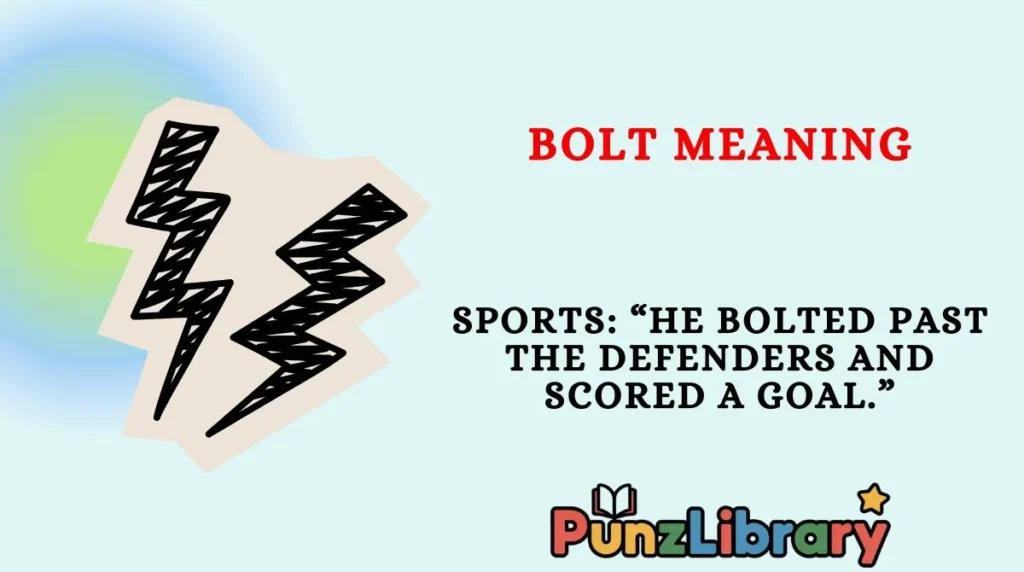
- Sports: “He bolted past the defenders and scored a goal.”
- Safety: “Always slide the bolt on your door at night.”
- Nature: “A bolt of lightning struck the tree nearby.”
- Figurative use: “She bolted out of the meeting when things got awkward.”
It’s versatile—physical, metaphorical, and even emotional. The key is context, which guides the meaning.
Emotional or Practical Meaning of Bolt
Why does the word bolt matter beyond its literal sense? Emotionally, it conveys suddenness, urgency, or force. Think about someone bolting from danger—that moment captures instinct and raw energy. In literature and conversation, using bolt can add intensity and vivid imagery, making your storytelling more dynamic.
Practically, understanding bolt ensures precision. If you’re giving instructions, using the wrong sense of the word could confuse someone. For example, telling someone to “bolt the door” versus “bolt out of the room” leads to completely different actions.
Similar or Related Terms
- Arrow: Like a bolt from a crossbow, but usually refers to projectiles.
- Dash: Focuses on speed; “bolted” implies urgency.
- Latch: Similar to a door bolt but less heavy-duty.
- Flash: Lightning-like action; a bolt of lightning = a flash.
- Sprint: A human-focused, fast movement; bolting emphasizes suddenness.
Common Misunderstandings About Bolt
- Bolt only means a screw or fastener: Wrong. It can also mean running or lightning.
- Bolt always implies danger: Not always; it can be neutral, like a door bolt.
- Bolt is formal language: Not necessarily; it’s conversational in many contexts.
- Bolt is only physical: It can be emotional or metaphorical.
- Bolt and dart are the same: Dart implies targeted speed; bolt can be sudden and unplanned.
- Bolt is rarely used: Actually, it’s common in daily speech and writing.
Examples of Bolt in Sentences
- “She bolted to the front of the line to grab the last ticket.”
- “The storm was fierce, and a bolt of lightning struck the barn.”
- “Check if all the bolts on the ladder are secure before climbing.”
- “He couldn’t wait any longer and bolted out of the meeting.”
- “Slide the bolt to lock the door behind you.”
- “The horse bolted when it heard the sudden noise.”
- “A bolt of inspiration hit her while she was cooking.”
- “They reinforced the gate with extra bolts for safety.”
Why Understanding Bolt Matters Today
Words like bolt shape how we communicate. In today’s fast-paced world, understanding a word with multiple dimensions helps in clarity, safety, and storytelling. Writers use it to add energy, parents use it to instruct, and engineers use it to describe parts. Recognizing the meaning in context makes you a more effective communicator, whether online, in business, or at home.
Frequently Asked Questions
What does bolt mean in simple words?
It’s something that moves fast, secures objects, or strikes suddenly—like a flash, a lock, or a quick dash.
Is bolt positive or negative?
It depends on context: a bolt of lightning could be dangerous, but bolting from a boring meeting is neutral.
Where is bolt commonly used?
In everyday conversation, construction, sports, literature, and weather descriptions.
Is bolt formal or informal?
It can be both. Talking about fasteners is formal; bolting out of a room is informal.
Why do people search for bolt?
To understand its multiple meanings, whether literal, figurative, or emotional.
Conclusion
The word bolt is simple yet powerful. It can describe speed, security, or sudden events, making it versatile and exciting. Understanding its meanings enriches your vocabulary and improves how you express yourself.
So next time something strikes fast, secures firmly, or moves suddenly, think of bolt—a word that captures the essence of energy, action, and safety in one neat package. Remember, language is alive, and every bolt you encounter is a little spark of understanding waiting to happen.