Have you ever watched a rabbit disappear into the ground and thought, where did it even go? That small tunnel it slips into is called a burrow—but the burrow meaning goes much deeper than a simple hole in the dirt.
In everyday life, we use this word not only for animals, but also to describe human behavior, emotions, and even habits. Someone might burrow into blankets on a cold night, or burrow into work when avoiding stress. Interesting, right?
Understanding the meaning of burrow helps you make sense of nature, language, and even people’s actions. It’s one of those everyday words that quietly carries visual imagery, emotion, and practicality all at once.
In this article, we’ll break down the burrow meaning in clear, human terms—no dictionary stiffness. You’ll see real-life examples, cultural context, common misunderstandings, and why this word still matters today. By the end, you won’t just know the definition—you’ll feel it.
What Does Burrow Mean?
At its core, the burrow meaning refers to a hole or tunnel dug into the ground, usually by an animal, to live in or stay safe.
But in human language, it also works as a verb.
In simple terms:
- As a noun: A burrow is a home underground.
- As a verb: To burrow means to dig into or hide deeply inside something.
Real-life examples:
- A fox creates a burrow to protect its babies from predators.
- You burrow under a blanket during winter because it feels warm and safe.
- A student burrows into books before an important exam.
See the pattern? Whether physical or emotional, burrow always suggests going deep for comfort, safety, or focus.
Origin and Background of the Term
The word burrow has been around for centuries. It comes from Middle English and is believed to be linked to old Germanic words meaning to dwell or to live inside.
Long before humans built houses, animals relied on burrows to survive harsh weather, predators, and danger. Ancient farmers closely observed animals like rabbits, badgers, and moles. Over time, the word naturally entered daily speech.
What’s fascinating is how humans borrowed the animal behavior and applied it metaphorically. Just like animals dig for safety, people retreat emotionally or focus deeply when life feels overwhelming.
That’s how burrow evolved from a survival term into a word rich with symbolism and emotional meaning.
How Burrow Is Used in Daily Life
We use burrow more often than we realize. Here are some practical, everyday uses:
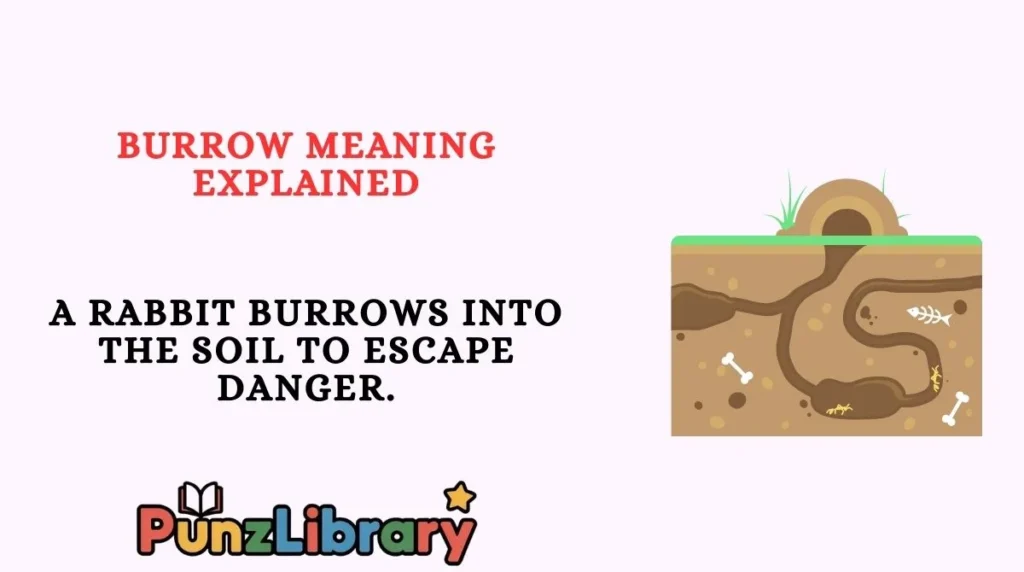
- A rabbit burrows into the soil to escape danger.
- A child burrows into their mother’s arms during fear.
- Someone burrows into their phone to avoid awkward conversation.
- A tired person burrows into pillows after a long day.
- A researcher burrows into data while preparing a report.
The word always implies depth, privacy, or intense focus—not just movement.
Emotional or Practical Meaning of Burrow
Beyond the physical definition, the burrow meaning carries a strong emotional layer.
Emotionally, burrowing often represents:
- Safety
- Comfort
- Withdrawal
- Focus
- Healing
In modern life, people “burrow” when they feel overstimulated or stressed. Think about scrolling quietly under a blanket or locking yourself in a room to recharge.
Socially, burrowing isn’t a weakness—it’s sometimes a survival strategy. Just like animals, humans need safe spaces too.
Understanding this helps us see that the word burrow describes a very human instinct: the need to protect ourselves emotionally and mentally.
Similar or Related Terms
Here are words often confused with burrow, with clear differences:
- Den – A shelter, but not always underground
- Nest – Built above ground, usually with soft materials
- Tunnel – A passage, not necessarily a living space
- Hideout – A secret place, often temporary
- Dig – The action, not the result
Each word overlaps slightly, but burrow specifically implies depth, shelter, and privacy.
Common Misunderstandings About Burrow
Let’s clear up some confusion:
- Burrow doesn’t only belong to animals
Humans use it metaphorically all the time. - It doesn’t always mean physical digging
Emotional and mental “burrowing” is common. - It’s not always negative
Burrowing can mean rest, safety, or focus. - Burrow isn’t the same as tunnel
Burrows are homes; tunnels are pathways. - It’s not childish language
Burrow is widely used in formal and informal writing.
Understanding these points helps you use the word confidently and correctly.
Examples of Burrow in Sentences
Here are natural, everyday examples:
- The rabbit disappeared into its burrow within seconds.
- She burrowed under the blanket to escape the cold.
- He burrowed into his work to forget his worries.
- The fox protected its young deep inside the burrow.
- After the argument, she burrowed into silence.
- The child burrowed closer to his father in the dark.
- I burrowed into the sofa after a long, tiring day.
Each sentence shows a slightly different—but connected—meaning.
Why Understanding Burrow Meaning Matters Today
Language shapes how we understand behavior—our own and others’.
In mental health discussions, burrowing explains withdrawal without judgment. In education, it describes deep focus. In storytelling, it creates strong visual emotion.
Knowing the burrow meaning helps you:
- Communicate more clearly
- Understand emotional behavior
- Write more descriptively
- Read between the lines
In today’s fast, noisy world, the idea of burrowing reminds us that rest and retreat are natural, not lazy.
Frequently Asked Questions
What does burrow mean in simple words?
Burrow means to dig into or hide deep inside something for safety, comfort, or focus.
Is burrow positive or negative?
It depends on context. It can be positive (comfort, safety) or neutral, not inherently negative.
Where is burrow commonly used?
It’s used in nature writing, everyday conversation, storytelling, psychology, and education.
Is burrow formal or informal?
It’s both. Suitable for casual speech and professional writing when used correctly.
Why do people search for burrow meaning?
Because it appears in books, conversations, and emotions, and people want to understand its deeper context as language evolves with time.
Conclusion
The burrow meaning isn’t just about animals digging holes—it’s about a universal instinct to seek safety, comfort, and focus. Whether it’s a rabbit underground or a human wrapped in blankets, the idea is beautifully shared.
Words like burrow remind us that language grows with life. And sometimes, stepping back, going quiet, and burrowing in isn’t avoidance—it’s self-care, survival, and strength.
So the next time you feel the urge to hide away for a bit, don’t fight it. Even the strongest creatures know when to retreat—and return stronger.