
Picture this: it’s early morning, your alarm just went off, and you’re already calculating how long it’ll take to get from home to work.
That daily movement—whether by car, bus, bike, or foot—is something millions of people experience without ever pausing to think about it. Yet, it holds more meaning than we realize.
When people search for commutes meaning, they’re not just looking for a definition.hey’re trying to understand a shared human experience—one that shapes routines, moods, and even life choices. A commute can be calm or chaotic, short or exhausting, enjoyable or draining .
simple terms, a commute is the journey between home and a regular place like work or school. But emotionally, it’s often the bridge between personal life and responsibility.
Understanding this word helps us talk about time, balance, productivity, and modern living more clearly.
So let’s break it down in a friendly, human way—no complicated language, no dictionary stiffness—just real meaning that fits everyday life.
What Does Commutes Meaning Mean?
At its core, commutes meaning refers to the regular travel a person makes between their home and another fixed place, most commonly a workplace or school.
Think about it like this:
- If you drive 30 minutes to work every morning, that drive is your commute.
- If a student takes a bus to college daily, that ride is their commute.
- Even walking to a nearby office counts.
A commute isn’t about distance alone—it’s about repetition and routine. It’s something you do regularly, often without thinking, yet it quietly influences how your day begins and ends.
Unlike a vacation trip or a random errand, a commute is predictable. It’s part of life’s rhythm, woven into weekdays and work schedules.
Origin and Background of the Term
The word “commute” has an interesting journey of its own.
It comes from the Latin word commutare, meaning “to change” or “to exchange.” Over time, this idea of switching or moving evolved. By the late 19th century, the term began appearing in English to describe regular travel, especially as cities expanded and people started living farther from where they worked.
When trains and public transport became common, daily travel turned into a shared urban experience. The word “commute” suddenly mattered. It gave language to a new lifestyle shaped by modern work culture.
So historically speaking, commuting isn’t just about travel—it’s about how society changed with industrial growth, cities, and jobs.
How Commutes Meaning Is Used in Daily Life
You’ll hear or use this word more often than you think. Here are some real-world ways it shows up:
- “My commute takes an hour each way.”
- “I switched jobs to shorten my commute.”
- “Remote work eliminated my daily commute.”
- “Traffic makes my commute stressful.”
- “I enjoy my commute—it’s my alone time.”
In casual conversation, “commute” often comes with emotion. People don’t just describe distance; they describe how it feels.
Short commute? Lucky.
Long commute? Exhausting.
That’s how deeply this word connects with daily life.
Emotional or Practical Meaning of Commutes Meaning
Beyond definition, commuting carries emotional weight.
For some, it’s peaceful time—listening to podcasts, reflecting, or enjoying music. For others, it’s draining—crowded buses, traffic jams, and lost hours.
Practically, commutes affect:
- Work-life balance
- Mental health
- Job satisfaction
- Family time
In modern culture, reducing commute time is often seen as a quality-of-life upgrade. That’s why work-from-home options feel so powerful—they give people time back.
A commute may seem small, but added together over years, it shapes how life feels.
Similar or Related Terms
Here are terms often confused with or related to commuting:
- Travel – General movement; not necessarily regular
- Journey – Often longer or one-time trips
- Transit – The system or method of traveling
- Daily travel – Descriptive phrase, less specific
- Errand – Short, occasional trips
The key difference? A commute is routine-based. It’s not random—it’s expected.
Common Misunderstandings About Commutes Meaning
Let’s clear up a few myths:
- Commute only means long-distance travel
Not true. Even a 10-minute walk can be a commute. - Only office workers have commutes
Students, freelancers, and part-time workers commute too. - Commutes must involve transport
Walking counts. So does cycling. - All commutes are stressful
Some people genuinely enjoy theirs. - Remote workers don’t commute at all
Some still commute to co-working spaces or meetings.
Understanding these nuances helps use the word correctly.
Examples of Commutes Meaning in Sentences
Here are natural, everyday examples:
- Her commute became shorter after she moved closer to work.
- He spends his commute listening to audiobooks.
- A long commute can affect your energy levels.
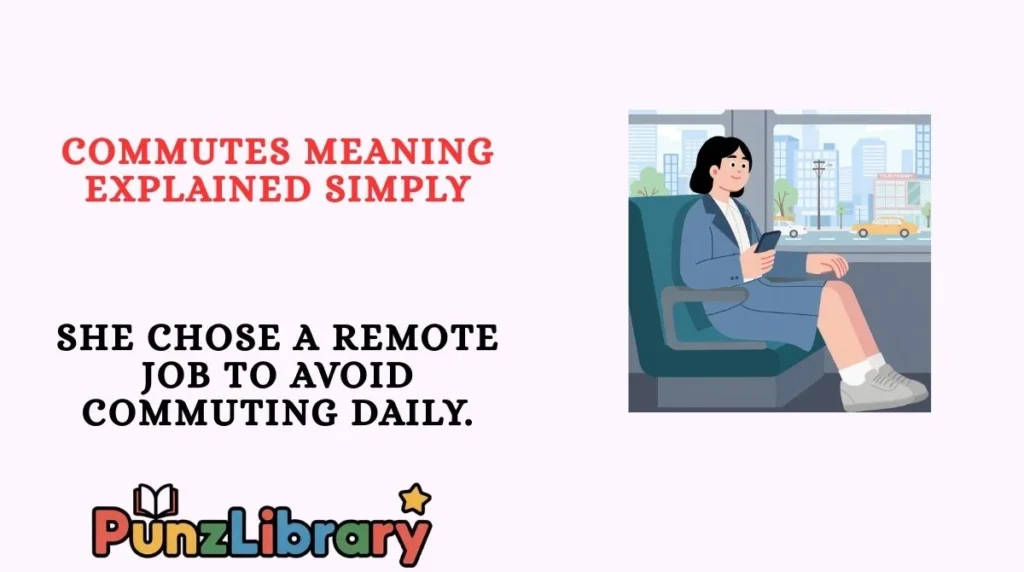
- She chose a remote job to avoid commuting daily.
- My commute used to be stressful, but I’ve adapted.
- Students often commute early in the morning.
- Weather can seriously impact your commute.
- A peaceful commute can set the tone for the day.
Why Understanding Commutes Meaning Matters Today
In today’s fast-paced world, time is valuable. Understanding what a commute represents helps people make smarter life decisions—where to live, what job to accept, or whether remote work fits better.
It’s also important culturally. Cities are designed around commuting patterns. Transportation systems, housing prices, and work policies all revolve around how people commute.
On a personal level, recognizing the impact of your commute can lead to better balance, healthier routines, and mindful living. It’s not just a word—it’s a daily reality.
Frequently Asked Questions
What does commutes meaning mean in simple words?
It means the regular travel between home and work or school.
Is commutes meaning positive or negative?
It’s neutral. The feeling depends on personal experience.
Where is commutes meaning commonly used?
In work, education, transportation, and everyday conversation.
Is commutes meaning formal or informal?
It’s neutral—used in both casual and professional settings.
Why do people search for commutes meaning?
Because it’s a common word tied to daily life, jobs, and routines, and people want clarity.
Conclusion
At first glance, a commute might seem like just another part of the day. But when you truly understand commutes meaning, you realize it’s more than movement—it’s time, energy, and emotion combined.
Whether your commute is five minutes or fifty, it quietly shapes how your days unfold. Becoming aware of that can help you make choices that protect your time and well-being.
Sometimes, improving life doesn’t require big changes—just a better understanding of the small things we live with every day. Your journey matters, even the everyday ones.