Have you ever noticed someone who always expects the worst or doubts people’s intentions? That’s what we often describe as cynicism.
It’s more than just a personality quirk—it’s a mindset that influences how we perceive the world, interact with others, and even make decisions. But what does cynicism really mean, and why does it matter today?
Understanding cynicism meaning helps us recognize both its advantages and its drawbacks. While a healthy dose of skepticism can protect us from being misled, extreme cynicism can harm relationships, career growth, and mental health.
Think about it: when someone constantly assumes the worst, they might miss opportunities, misjudge intentions, or even isolate themselves from meaningful experiences.
In this article, we’ll break down cynicism in simple, relatable terms, explore its origins, and examine its role in daily life. By the end, you’ll not only understand the term fully but also see how it can impact your own life—and maybe even learn how to balance it effectively.
What Does Cynicism Mean?
At its core, cynicism is a mindset where someone distrusts others’ motives, often assuming that people act primarily out of self-interest. It’s that little voice that says, “Why is she being nice? What’s in it for her?”
Examples in real life:
- A coworker gets a compliment, but a cynic thinks, “She probably wants a favor later.”
- Someone donates to charity, and a cynic says, “It’s just for tax benefits.”
- You see politicians making promises, and a cynic immediately assumes ulterior motives.
Notice how cynicism isn’t always about negativity—it’s about skepticism mixed with doubt, often applied to human behavior and societal norms.
Origin and Background of the Term
The word “cynicism” traces back to ancient Greece, particularly the Cynic philosophers like Diogenes of Sinope. These thinkers rejected societal conventions and materialism, advocating for a life of honesty and simplicity.
Diogenes, for instance, famously lived in a barrel and carried a lamp in daylight, claiming he was “looking for an honest man.” While the original Cynics focused on virtue and rejecting hypocrisy, over time, the term shifted. Today, cynicism often carries a more negative connotation, implying distrust and skepticism rather than philosophical discipline.
Understanding this history helps us see cynicism not just as doubt, but as a concept rooted in questioning society and human behavior.
How Cynicism Is Used in Daily Life
Cynicism shows up in subtle ways every day:
- At work: You might assume a colleague’s praise has hidden motives.
- In politics: Many people distrust politicians’ promises by default.
- In friendships: You might question whether someone is being kind or seeking personal gain.
- In media consumption: Headlines make you suspicious, thinking, “They’re exaggerating for clicks.”
- In relationships: A cynical partner may doubt sincerity, making trust harder.
- In social movements: Some people question whether advocacy is genuine or self-serving.
In moderation, cynicism can protect you from being naive—but too much can strain connections and foster negativity.
Emotional or Practical Meaning of Cynicism
Cynicism affects more than our thoughts—it shapes emotions and behavior.
- Emotionally, cynics might feel less disappointment when things go wrong because they expect it.
- Practically, cynicism can prevent you from being exploited or misled.
However, extreme cynicism can lead to social isolation, chronic suspicion, and even stress. Understanding the emotional and practical meaning helps balance skepticism with optimism.
Similar or Related Terms
Here are a few terms related to cynicism:
- Skepticism: Doubt focused on questioning claims; less about personal motives.
- Pessimism: Expecting bad outcomes; more general, not necessarily about others’ intentions.
- Realism: Seeing things as they are, not overly optimistic or negative.
- Misanthropy: Dislike or distrust of humanity; stronger than everyday cynicism.
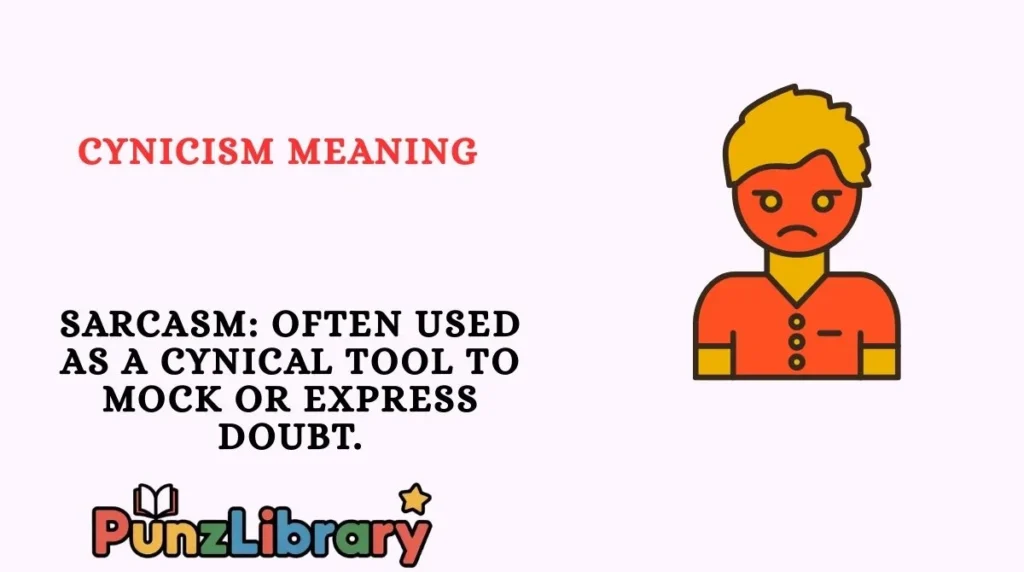
- Sarcasm: Often used as a cynical tool to mock or express doubt.
The key difference? Cynicism targets motives, not just outcomes or situations.
Common Misunderstandings About Cynicism
- Cynicism is always negative: Not true—it can be protective.
- Cynics can’t trust anyone: Some trust selectively, using caution wisely.
- Cynicism equals pessimism: Cynicism doubts motives; pessimism doubts outcomes.
- Cynicism is modern: It’s been around since ancient Greece.
- All cynics are unhappy: Many lead fulfilling lives while staying cautious.
- Cynicism means rejecting kindness: Cynics can appreciate good intentions—they just question them first.
Examples of Cynicism in Sentences
- She smiled, but his cynicism made him wonder what she really wanted.
- His cynicism about corporate promises made him a cautious investor.
- I respect her intelligence, but her cynicism sometimes puts people off.
- Political scandals have fueled public cynicism across generations.
- Even in acts of kindness, his cynicism kept him skeptical.
- The movie was entertaining, but I watched it with mild cynicism.
- Cynicism can protect you, but too much can cloud judgment.
- Despite her cynicism, she still believed small acts of honesty mattered.
Why Understanding Cynicism Matters Today
In a world of social media, fake news, and political spin, understanding cynicism is more relevant than ever. It allows us to:
- Evaluate motives wisely without being naive.
- Recognize when skepticism is healthy versus harmful.
- Communicate better by knowing why someone might doubt you.
- Reflect on our own mindset, avoiding unnecessary negativity.
Ultimately, understanding cynicism helps us navigate modern life with awareness and balance.
Frequently Asked Questions
What does cynicism mean in simple words?
Cynicism is doubting people’s motives or assuming they act mostly out of self-interest.
Is cynicism positive or negative?
It can be both—positive when it prevents being misled, negative if it fosters distrust or isolation.
Where is cynicism commonly used?
Everywhere—from workplaces and politics to social media and personal relationships.
Is cynicism formal or informal?
It’s neutral: can be used in everyday conversation and formal writing.
Why do people search for cynicism?
People want to understand their own doubts, others’ behavior, or how to balance skepticism in daily life.
Conclusion
Cynicism is a double-edged sword—it can protect us from deception, but excessive cynicism can block trust, joy, and growth .
By understanding its meaning, origins, and daily impact, we gain the tools to balance skepticism with openness, navigating life smarter and more emotionally aware.
Remember: a touch of cynicism is wise—but don’t let it stop you from believing in the goodness around you. Life is too rich to miss out on connection.