You finish a book, close the last page, and just when you think the story is over… there’s one more section. It’s calm, reflective, and often emotional. That part is called an epilogue—and it quietly changes how we remember the entire story.
The epilogue meaning isn’t complicated, but it’s often misunderstood. In simple terms, an epilogue gives readers a final moment with the story after the main ending. It’s like meeting an old friend years later and seeing how life turned out.
Understanding this word matters more than you think. Whether you’re a student, reader, writer, or just someone who loves words, knowing what an epilogue is helps you better understand books, movies, and even real-life storytelling.
In this article, we’ll break down the meaning in easy, human language, share real-life examples, clear up misconceptions, and show why this small section often carries big emotional weight.
What Does Epilogue Meaning Actually Mean?
An epilogue is the final section of a story that comes after the main plot has ended. It doesn’t introduce new conflicts. Instead, it shows what happens after everything is resolved.
Think of it like the calm after a storm.
For example:
- In a novel, the main character wins the battle, and the epilogue shows their peaceful life years later.
- In a movie, the villain is defeated, and the epilogue shows where each character ended up.
- In real life, it’s like a retirement speech that reflects on a long career.
The epilogue isn’t about excitement—it’s about closure, reflection, and meaning.
Origin and Background of the Term
The word epilogue comes from ancient Greek. It’s formed from two words:
- epi meaning “after”
- logos meaning “speech” or “story”
So literally, an epilogue means “after the story.”
In ancient Greek plays, epilogues were spoken directly to the audience. The actor would step forward, break the fourth wall, and explain what the audience should take away from the story.
Over time, writers adopted the epilogue into novels, poems, and later, films. What started as a spoken explanation slowly became a quiet, reflective ending—the kind we recognize today.
How Epilogue Is Used in Daily Life
Although it’s a literary term, epilogue shows up more often than you might realize.
Here are some practical examples:
- In books, to show life after the main conflict
- In movies, to explain character futures
- In TV series finales, as a final montage
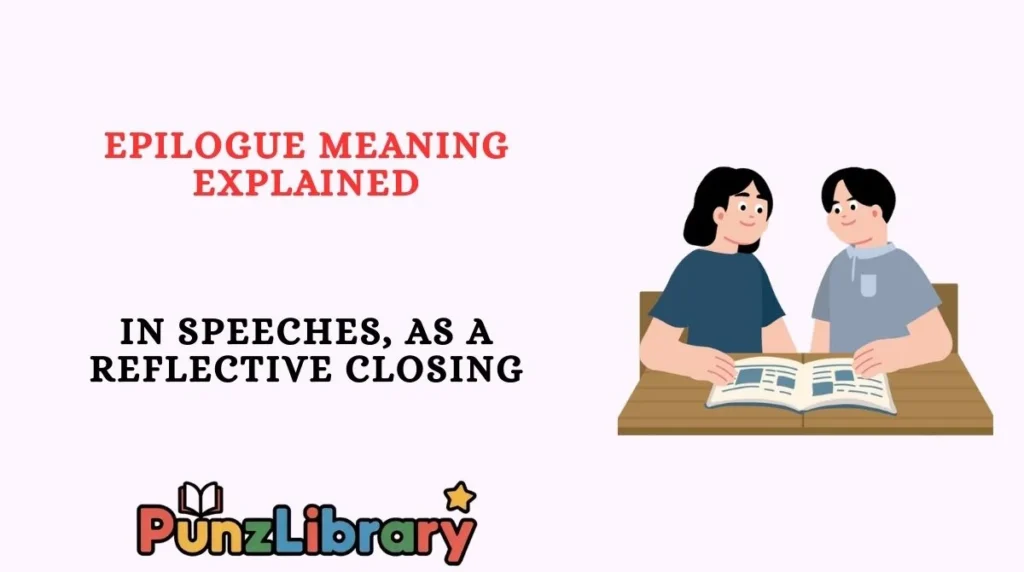
- In speeches, as a reflective closing
- In personal writing, like memoirs or journals
- In life, people even call retirement or late-life chapters an “epilogue”
We naturally think in epilogues because humans love ending stories with meaning.
Emotional and Practical Meaning of Epilogue
Emotionally, an epilogue provides peace.
It answers the questions we didn’t know we were still asking:
- Did they end up happy?
- Did the sacrifice matter?
- Did life go on?
From a practical view, epilogues help readers mentally detach from a story. Without one, endings can feel abrupt or incomplete.
In today’s fast-moving world, epilogues remind us that life doesn’t end at the climax. There’s always an “after.” And sometimes, that “after” is where the real meaning lives.
Similar or Related Terms
Here are words often confused with epilogue, explained simply:
- Prologue – An opening that comes before the main story
- Conclusion – Final summary or ending of a text
- Afterword – Author’s personal comments after the story
- Postscript – A short added note at the very end
- Ending – Where the main plot officially stops
👉 The key difference?
An epilogue is part of the story, not just commentary.
Common Misunderstandings About Epilogue
Many people get epilogues wrong. Let’s clear things up.
- “An epilogue is optional fluff”
Not true. Some epilogues are essential for emotional closure. - “It repeats the ending”
No. It moves beyond the ending. - “It introduces new drama”
An epilogue reflects—it doesn’t restart chaos. - “Only novels use epilogues”
Movies, plays, and even real-life speeches use them too. - “You can skip it”
You can, but you might miss the heart of the story.
Examples of Epilogue in Sentences
Here are natural, everyday sentence examples:
- The book’s epilogue showed the characters ten years later.
- I loved the epilogue because it gave me emotional closure.
- The movie’s epilogue explained what happened after the war.
- Her speech felt like an epilogue to a long journey.
- The author used an epilogue to reflect on loss and hope.
- That final chapter worked as a quiet epilogue.
- Life felt like an unexpected epilogue after retirement.
Why Understanding Epilogue Meaning Matters Today
In a world obsessed with fast endings and instant results, epilogues slow us down.
They teach us that:
- Growth happens after struggle
- Meaning appears after chaos
- Reflection matters as much as action
For students, it improves reading comprehension.
For writers, it strengthens storytelling.
For readers, it deepens emotional connection.
Understanding the epilogue meaning helps us appreciate not just how stories end—but how they continue.
Frequently Asked Questions
What does epilogue mean in simple words?
An epilogue is the final part of a story that shows what happens after the main ending.
Is epilogue positive or negative?
Usually positive or reflective. It focuses on resolution, not conflict.
Where is epilogue commonly used?
In books, movies, plays, speeches, and sometimes life storytelling.
Is epilogue formal or informal?
It’s neutral. Common in formal writing but understood casually too.
Why do people search for epilogue meaning?
Because it’s often misunderstood and plays an important role in stories.
Conclusion
An epilogue isn’t just an ending—it’s a gentle goodbye, a final look back, and sometimes a hopeful glance forward. Understanding the epilogue meaning helps us see stories the way they’re meant to be seen: not as sudden stops, but as lived journeys.
And maybe that’s the real lesson—every ending deserves a moment of reflection. Even in life, our epilogues often hold the most wisdom. 🌱