Have you ever heard the term “feudal” and wondered what it really means? Maybe you came across it in a history class, a book, or even in casual conversation and felt a little confused.
Don’t worry—you’re not alone. Many people use the word without fully understanding its depth or origin. Feudal meaning isn’t just a historical term; it reflects a complex system that shaped societies, economies, and even our modern way of thinking about power and hierarchy.
In this article, we’ll break it down in simple, human terms. You’ll learn what feudal really means, its historical roots, and how it still affects daily life today.
By the end, you’ll not only understand the word but also gain insights into why knowing it matters. Let’s dive in and make history—and language—come alive.
What Does Feudal Mean?
At its core, feudal describes a social and economic system where land is owned by a few powerful people, and others work on that land in exchange for protection or services. Think of it as a give-and-take relationship with strict roles and responsibilities.
In simple terms:
- The lord or noble owns the land.
- The vassals or peasants work it and provide loyalty, crops, or services.
- Everyone’s status and rights are determined by this hierarchy.
Real-life example: Imagine a landlord owning a farm today, and farmers work the land not for wages but for protection or a share of the harvest. While rare now, this system was the backbone of many medieval societies.
Another example is in storytelling or movies—when you see knights serving kings or peasants tending to the land, that’s feudalism in action. It’s not just history; it’s a pattern of structured obligations between different social levels.
Origin and Background of the Term
The word “feudal” comes from the Latin term feodum or feudum, which means “fief”—a piece of land granted by a lord to a vassal in exchange for loyalty. This system flourished in medieval Europe around the 9th to 15th centuries.
Picture Europe after the fall of the Roman Empire: central governments were weak, and people needed protection. Local lords offered safety and land to peasants, who, in return, promised loyalty and labor. Over time, this hierarchical system became deeply ingrained in society, influencing law, culture, and even warfare.
It’s fascinating to realize that while feudalism seems distant, its concepts of loyalty, service, and hierarchy still appear in modern organizations, governments, and even businesses.
How Feudal Is Used in Daily Life
Even though medieval feudalism isn’t around anymore, the term “feudal” is used metaphorically or descriptively in modern contexts. Here are some examples:
- Workplace hierarchy: Some companies have rigid chains of command. Employees joke about a “feudal boss” who treats staff like vassals.
- Land ownership debates: When a few people own most property, it’s sometimes called a “feudal system” in articles or discussions.
- Online games: Many strategy games mimic feudal structures—players manage land, peasants, and armies.
- Pop culture references: Films and books set in medieval times often depict feudal relationships for authenticity.
- Political commentary: Authors may describe governments or institutions with strict class divisions as “feudal” to illustrate inequality.
These examples show that feudalism isn’t just history; it’s a concept we use to understand hierarchy, power, and responsibility even today.
Emotional or Practical Meaning of Feudal
Understanding feudal meaning isn’t just academic—it gives insight into human behavior and society. Feudal systems highlight loyalty, duty, and hierarchy, emotions that are still relevant in workplaces, communities, and families.
Practical significance: By studying feudal structures, we learn how social inequality forms, why people submit to authority, and how trust and protection operate in complex networks.
Cultural impact: Literature, movies, and even video games borrow feudal ideas to show struggles between classes, the weight of responsibility, or the tension between power and fairness. Recognizing these themes makes us more aware of modern hierarchies and personal roles in society.
Similar or Related Terms
- Manorial system: Focuses on the lord’s estate rather than the broader political hierarchy.
- Vassalage: The system of loyalty and service between lords and vassals.https://en.wikipedia.org/wiki/Feudalism
- Serfdom: Status of peasants bound to the land they work on.
- Hierarchy: A general term for structured levels of power.
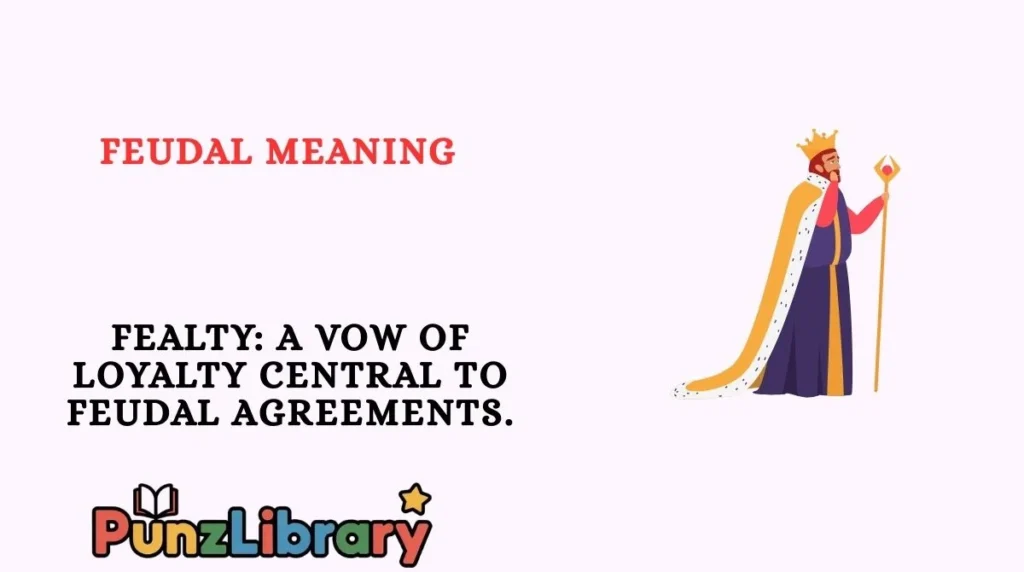
- Fealty: A vow of loyalty central to feudal agreements.
These terms overlap with feudalism but differ in scope—some focus on land, others on loyalty, and some on social rank.
Common Misunderstandings About Feudal
- Feudal means medieval castles only: Not true; it refers to the system, not just buildings.
- Everyone was poor: While peasants often had hard lives, nobles and knights benefited.
- Feudalism was the same everywhere: It varied by country and culture.
- It disappeared instantly: The decline was gradual and influenced modern governance.
- It’s purely negative: Feudalism provided stability and protection in uncertain times.
- Feudal means unfairness only: While hierarchical, it was also about mutual obligations.
Clearing these misconceptions helps us appreciate feudalism’s nuance beyond the stereotypes.
Examples of Feudal in Sentences
- The kingdom had a feudal system, with knights serving their lords loyally.
- Some argue that modern corporate structures are feudal in nature.
- In history class, we learned how feudal relationships governed daily life.
- The movie depicted a feudal society with strict social hierarchies.
- His farm operated in a feudal style, trading labor for protection.
- Writers often use feudal settings to explore themes of loyalty and betrayal.
- The political analyst described the region as having a quasi-feudal structure.
- Even today, some remote areas follow feudal traditions informally.
Why Understanding Feudal Matters Today
Knowing the feudal meaning gives us more than historical knowledge—it offers insight into human relationships and societal structures. Feudal systems teach lessons about loyalty, responsibility, and inequality that still resonate.
Whether you’re reading history, analyzing workplace dynamics, or playing a medieval strategy game, understanding feudalism provides context and perspective. It’s a reminder that while times change, the core dynamics of power and duty remain remarkably similar.
Frequently Asked Questions
What does feudal mean in simple words?
Feudal describes a system where landowners provide protection and people work the land or offer services in return.
Is feudal positive or negative?
It depends on perspective. It ensured protection and order but also reinforced inequality.
Where is feudal commonly used?
You’ll see it in history, literature, gaming, politics, and cultural discussions.
Is feudal formal or informal?
It’s mostly formal when describing systems or history, but can be informal metaphorically.
Why do people search for feudal?
People want to understand history, social structures, or use it metaphorically to describe modern hierarchies and relationships.
Conclusion
Understanding the feudal meaning isn’t just about history—it’s about connecting the past to the present. It teaches us lessons about loyalty, hierarchy, and social responsibility, making our interpretation of society richer and more nuanced.
Next time you hear the word “feudal,” think beyond castles and kings—see the patterns of power and human connection that echo through time.
Remember: Even in modern life, understanding old systems can inspire better choices, empathy, and awareness.