If you’ve ever traveled to a bustling city or a theme park, chances are you’ve seen a monorail gliding smoothly above the ground, effortlessly connecting places. But what exactly is a monorail?
Many people have a vague idea, picturing futuristic trains or amusement park rides, but the term “monorail” has more depth than it seems.
Understanding its meaning isn’t just about learning transportation lingo—it’s about appreciating how humans innovate and rethink mobility.
Whether you’re a curious traveler, a student, or just someone who loves cool tech, knowing what a monorail is can make everyday observations more interesting.
From city planning to fun vacations, monorails appear in places you might never expect. In this article, we’ll break down the monorail meaning, explore its origins, practical uses, and even some misconceptions. By the end, you’ll have a clear, human-friendly understanding of this fascinating mode of transport.
What Does Monorail Mean?
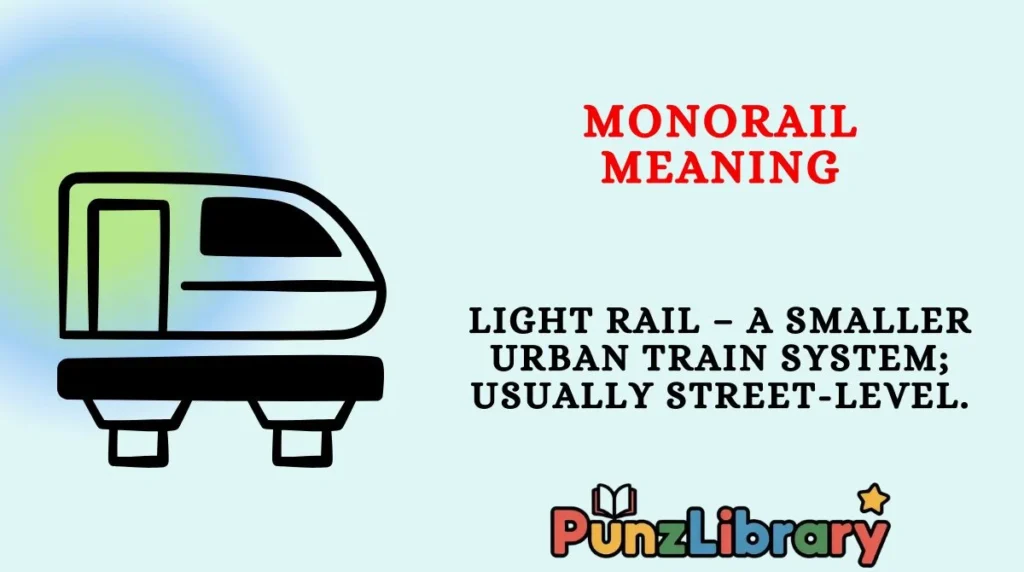
Simply put, a monorail is a train that runs on a single rail. Unlike traditional trains that use two parallel tracks, monorails rely on one beam or track, often elevated above the ground. This unique design allows monorails to weave through crowded areas without taking up much space.
Real-life examples:
- The monorail at Disneyland effortlessly connects different sections of the park while giving riders a scenic view from above.
- Cities like Tokyo and Kuala Lumpur use monorails to reduce congestion in busy urban areas.
- Some airports have monorails shuttling passengers between terminals, making transfers fast and efficient.
The key idea is single-track movement, which makes monorails visually distinct and often associated with futuristic travel.
Origin and Background of the Term
The word “monorail” comes from two parts: “mono”, meaning single, and “rail”, meaning track. Its first concepts appeared in the early 19th century, when engineers were experimenting with alternatives to traditional railways.
In 1821, Henry Robinson Palmer patented the first monorail design in England, envisioning a train balanced on a single rail. Although initial versions weren’t widely adopted, the idea sparked decades of innovation. By the mid-20th century, monorails became symbols of modern urban transport, with cities experimenting with elevated systems that could avoid traffic and obstacles.
Interestingly, monorails often carry a cultural aura of futurism, appearing in sci-fi movies and futuristic city plans long before they became practical in real life.
How Monorail Is Used in Daily Life
Monorails aren’t just for big cities or theme parks—they show up in various ways:
- Public transit in cities – Cities like Chongqing in China rely on monorails to transport thousands daily.
- Airport shuttles – Airports use monorails to connect terminals efficiently, saving time for travelers.
- Tourist attractions – Many theme parks, zoos, and resorts use monorails to give visitors a bird’s-eye view of attractions.
- Urban commuting shortcuts – Some urban areas use monorails to bypass traffic-heavy streets, providing fast and scenic rides.
- Special events – Temporary monorails are sometimes installed for exhibitions or fairs, showcasing their flexibility.
In all cases, the monorail offers efficiency, novelty, and space-saving design.
Emotional or Practical Meaning of Monorail
The practical meaning of a monorail is transportation efficiency, but its emotional or cultural significance is just as fascinating. Many people associate monorails with futuristic cities, innovation, and effortless travel. Riding a monorail can feel like stepping into a sci-fi world—gliding above streets while life bustles below.
Culturally, monorails are symbols of human ingenuity. They represent the desire to overcome limits: congested streets, uneven terrain, or urban sprawl. They also spark nostalgia for childhood memories of theme park rides and futuristic films.
Similar or Related Terms
- Train – Runs on two rails; generally heavier and for longer distances.
- Light rail – A smaller urban train system; usually street-level.
- Cable car – Pulled by cables instead of running on tracks.
- Monocable gondola – Aerial transport using a single cable; similar in concept but airborne.
- Skytrain – Elevated rail system; often confused with monorails but may use two rails.
The difference lies mainly in track structure, purpose, and elevation.
Common Misunderstandings About Monorail
- Monorails are only for amusement parks – False; they’re practical urban transport too.
- They’re slower than normal trains – Not necessarily; some monorails can reach high speeds.
- They’re unsafe – Modern monorails are engineered with advanced safety measures.
- They’re always elevated – Some run at ground level, though many are raised.
- All monorails are futuristic-looking – Designs vary; some look very traditional.
- Monorail = Maglev – Maglev trains use magnets; monorails don’t need them.
Examples of Monorail in Sentences
- The Disneyland monorail gave us a perfect view of the park from above.
- Tokyo’s monorail makes commuting a breeze during rush hour.
- We hopped on the airport monorail to reach our gate in minutes.
- The futuristic city plan included monorails connecting every district.
- Children were fascinated by the colorful monorail ride at the zoo.
- Engineers debated whether a monorail or light rail would suit the city best.
- Riding a monorail feels like floating above the traffic below.
- The exhibition showcased a prototype monorail designed for urban rooftops.
Why Understanding Monorail Matters Today
Monorails are more than just a transportation novelty. In today’s urbanized world, understanding them helps us appreciate innovations in space-saving design, eco-friendly travel, and futuristic planning. As cities grow, monorails may become a key solution to traffic congestion, connecting communities efficiently while reducing environmental impact.
Moreover, knowing the monorail meaning enriches cultural literacy. It helps you understand city layouts, read urban planning discussions, and even appreciate the engineering marvels in theme parks or sci-fi media. Monorails remind us that human creativity can turn a single rail into a world of possibilities.
Frequently Asked Questions
What does monorail mean in simple words?
A monorail is a train or transit system that moves on a single rail instead of two tracks.
Is monorail positive or negative?
It’s neutral, but usually has a positive association with innovation and futuristic travel.
Where is monorail commonly used?
Monorails appear in cities, airports, theme parks, and special events.
Is monorail formal or informal?
The term is neutral; it’s used in technical, casual, and media contexts.
Why do people search for monorail?
People are curious about urban transport, travel options, and futuristic designs, or they’ve seen it in movies, parks, or city maps.
Conclusion
In essence, a monorail isn’t just a single-rail train—it’s a symbol of human innovation, creativity, and the quest for efficient travel. From bustling cities to theme parks, it adds convenience, fun, and a touch of futurism to our daily lives.
The next time you spot a monorail gliding overhead, remember: it’s more than a train—it’s a testament to how humans reimagine movement and possibilities. Embrace curiosity, and let every ride remind you that even a single rail can open up endless journeys.