If you’ve ever stumbled across the word “ore” and wondered what it really means, you’re not alone. While it may sound like a simple word, it carries layers of meaning—both in everyday conversation and in the scientific world.
Understanding ore isn’t just for geology students; it can open doors to appreciating the natural world, history, and even modern technology.
In this article, we’ll break down the meaning, origin, usage, and significance of ore in a way that’s easy to understand. We’ll explore practical examples, debunk common myths, and even touch on its cultural and emotional value. By the end, you’ll not only know what ore means but also why it matters today.
What Does Ore Mean?
At its core, ore refers to a naturally occurring rock or mineral that contains a valuable substance—usually a metal—that can be extracted profitably. In simple words, it’s a rock with a hidden treasure inside.
For example:
- Iron ore is the rock that contains iron, which is later used to make steel.
- Gold ore is mined for gold, which is then refined into jewelry or coins.
- Copper ore is processed to produce copper wires and electronics.
Think of ore as nature’s way of storing precious resources, waiting for humans to extract and use them. Unlike ordinary rocks, ore is valuable because of what it contains, not just what it looks like.
Origin and Background of the Term
The word “ore” has roots in Old English and Latin. It comes from the Old English word ōra, meaning “unwrought metal” or “metal in its natural state.” Over time, the term evolved to refer specifically to rocks containing extractable metals.
Historically, ore has been a cornerstone of human civilization. From ancient Egyptians mining copper to build tools, to modern miners extracting rare earth elements for smartphones, ore has always shaped society. Imagine the Bronze Age without tin and copper ores—our tools, weapons, and art would be entirely different.
How Ore Is Used in Daily Life
You might not handle ore directly every day, but it affects nearly everything around you. Here are a few practical examples:
- Buildings and Infrastructure – Steel made from iron ore is in bridges, skyscrapers, and even your local school.
- Technology – Copper ore is crucial for wiring in your phone, computer, and household appliances.
- Jewelry – Gold and silver ores are the starting point for rings, necklaces, and coins.
- Transportation – Aluminum from bauxite ore is used in airplanes, cars, and bicycles.
- Energy – Uranium ore is essential for nuclear power generation in some countries.
Even if you never step into a mine, ore touches your life in countless ways every single day.
Emotional or Practical Meaning of Ore
Ore isn’t just a geological term—it carries symbolic meaning. Extracting ore has historically represented wealth, opportunity, and progress. Communities have grown around mines, families have built futures on mining industries, and entire civilizations have flourished thanks to valuable ores.
In a modern context, understanding ore helps us appreciate sustainable mining practices, environmental concerns, and the technological innovations that rely on these natural resources. It’s a reminder that even rocks can hold enormous potential, much like untapped talents in people.
Similar or Related Terms
Here are some terms closely related to ore:
- Mineral – Naturally occurring substances in rocks. Not all minerals are ores.
- Metal – Extracted from ore and refined for use.
- Gangue – The worthless material surrounding valuable ore.
- Smelting – The process of extracting metal from ore.
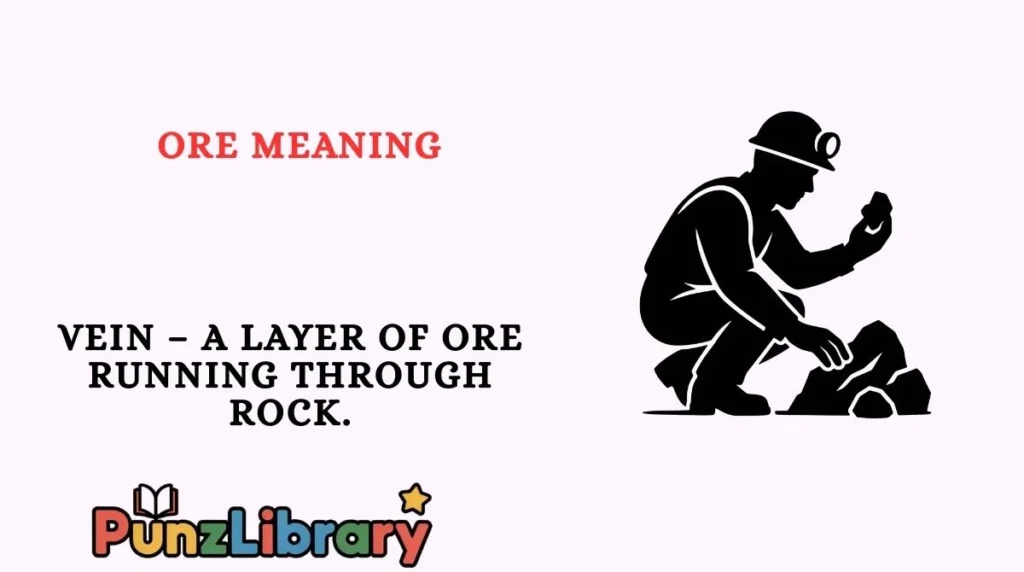
- Vein – A layer of ore running through rock.
Each term is connected to ore but focuses on different aspects of mining, geology, or processing.
Common Misunderstandings About Ore
People often confuse ore with simple rocks or metals. Let’s clear up some common misconceptions:
- “All rocks are ores.” – Not true; only rocks with extractable valuable minerals are ores.
- “Ore is pure metal.” – Wrong. Ore contains metal mixed with other materials.
- “Ore has no use until mined.” – Correct, but its potential value exists naturally.
- “Ore is only for gold or silver.” – False; iron, copper, bauxite, and many more are ores.
- “Ore mining is always destructive.” – Not entirely; sustainable mining practices exist today.
Understanding these clarifications prevents confusion in science, industry, and casual conversation.
Examples of Ore in Sentences
Here are some friendly, everyday ways to use the word ore:
- The workers discovered a rich iron ore deposit near the mountains.
- Gold ore is carefully mined and refined into beautiful jewelry.
- Copper ore is essential for producing the wiring in your home.
- Many countries rely on importing rare ores to power their technology.
- The geologist studied the rock and confirmed it contained valuable ore.
- Mining companies must balance profit with environmental care when extracting ore.
- Ancient civilizations thrived because of accessible metal ores.
- Aluminum is produced from bauxite ore, which is abundant in some regions.
Why Understanding Ore Matters Today
In today’s world, ore has more relevance than ever. Modern technology—smartphones, electric cars, renewable energy—depends on metals extracted from ore. Learning about ore also promotes awareness of resource management, recycling, and sustainable practices.
On a personal level, understanding ore can spark curiosity about geology, history, and engineering. Knowing where your phone’s copper comes from or how steel reaches skyscrapers connects you to the bigger picture: the fascinating journey from rock to modern life.
Frequently Asked Questions
What does ore mean in simple words?
Ore is a rock that contains valuable metals or minerals which can be extracted and used. Think of it as nature’s hidden treasure.
Is ore positive or negative?
Ore is neutral—it’s simply a natural resource. Its impact depends on how humans use it.
Where is ore commonly used?
Ore is used in construction, technology, transportation, energy, and jewelry.
Is ore formal or informal?
Ore is a neutral, mostly formal term used in science, industry, and education.
Why do people search for ore?
People search for ore to understand mining, metal extraction, geology, and even economic opportunities.
Conclusion
Ore might seem like a simple word, but it represents nature’s hidden potential. From ancient civilizations to modern technology, it has shaped our world in countless ways.
Understanding ore connects us to history, industry, and the environment, reminding us that even ordinary rocks can carry extraordinary value.
Next time you see a rock, remember: it might just be holding a treasure waiting to be discovered. Embrace curiosity, explore knowledge, and let the small wonders of the world inspire big dreams.