When we hear the word “perpetrator,” it often carries a heavy, serious connotation. But what does it truly mean, and why does understanding this term matter in everyday life?
From legal contexts to social discussions, knowing exactly who a perpetrator is and what the word implies can help us navigate conversations about responsibility, crime, and justice with clarity and confidence.
In this article, we’ll break down the perpetrator meaning, explore its origins, discuss how it’s used in daily life, and clarify common misconceptions.
the end, you’ll see that this isn’t just a word for lawyers or news reports—it’s a term with practical, emotional, and social significance.
Whether you’re studying law, psychology, or simply want to understand conversations about wrongdoing better, this guide has you covered.
What Does Perpetrator Mean?
At its core, a perpetrator is someone who commits a harmful, illegal, or wrongful act. It’s not about gossip or assumptions—it’s a formal term used to identify the person responsible for an offense, crime, or immoral action.
Here are a few real-life examples to make it clear:
- If someone steals a bike from a park, the person who took it is the perpetrator of theft.
- In cyberbullying, the individual sending hurtful messages is the perpetrator.
- Even in smaller situations, like spreading false rumors deliberately, the instigator can be considered a perpetrator of harm.
Notice how the word always points to action and responsibility. It doesn’t label someone permanently “bad,” but it identifies them in relation to a particular wrongdoing.
Origin and Background of the Term
The word perpetrator comes from the Latin perpetratus, which means “carried out” or “performed.” Over time, English adopted it to describe someone who carries out a crime or harmful act.
Imagine medieval courts where scribes documented crimes. They needed a word to formally indicate who did what, without resorting to insult or speculation. Perpetrator became that neutral, legal identifier—a term that could be used in law, news, and scholarly discussions alike.
It’s fascinating because the word is both descriptive and formal. Unlike “criminal,” which often implies moral judgment, perpetrator strictly points to the act someone committed. It emphasizes responsibility, not personality.
How Perpetrator Is Used in Daily Life
Even outside legal settings, the concept of a perpetrator shows up in multiple areas:
- Law and Justice: Court cases, police reports, and investigations always identify the perpetrator of an offense.
- News and Media: Journalists describe incidents carefully, referring to the perpetrator to explain events without defaming anyone until proven guilty.
- Workplace Situations: In cases of harassment or unethical behavior, the person committing the act is sometimes labeled the perpetrator in HR reports.
- Education and Awareness: Programs about bullying or cybercrime often discuss identifying the perpetrator and understanding their actions to prevent future harm.
- Social Discussions: Talking about accountability in communities, families, or online, the term helps separate the act from the individual, keeping conversations precise.
Understanding the term allows us to communicate clearly about responsibility, justice, and consequences—without unnecessary labeling or exaggeration.
Emotional or Practical Meaning of Perpetrator
The emotional weight of “perpetrator” can be significant. It signals that harm has occurred, prompting awareness, caution, and sometimes fear. Yet, using the term responsibly can also promote fairness and justice:
- Emotionally: It helps victims articulate their experiences, naming the actions and the one responsible. This can be empowering.
- Practically: In law enforcement or organizational settings, clearly identifying the perpetrator is crucial for accountability, preventing repeat offenses, and delivering justice.
- Socially: The term encourages discussions about cause and effect—teaching communities the difference between action and intention.
In modern society, where misinformation spreads quickly, distinguishing the perpetrator of an act from rumors or assumptions is essential for clarity and fairness.
Similar or Related Terms
Here are some terms related to perpetrator, with clear distinctions:
- Offender: A person who breaks the law; similar, but can apply to minor violations too.
- Culprit: Informal term for someone responsible for a wrongdoing.
- Suspect: Someone believed to have committed a crime but not yet proven guilty.
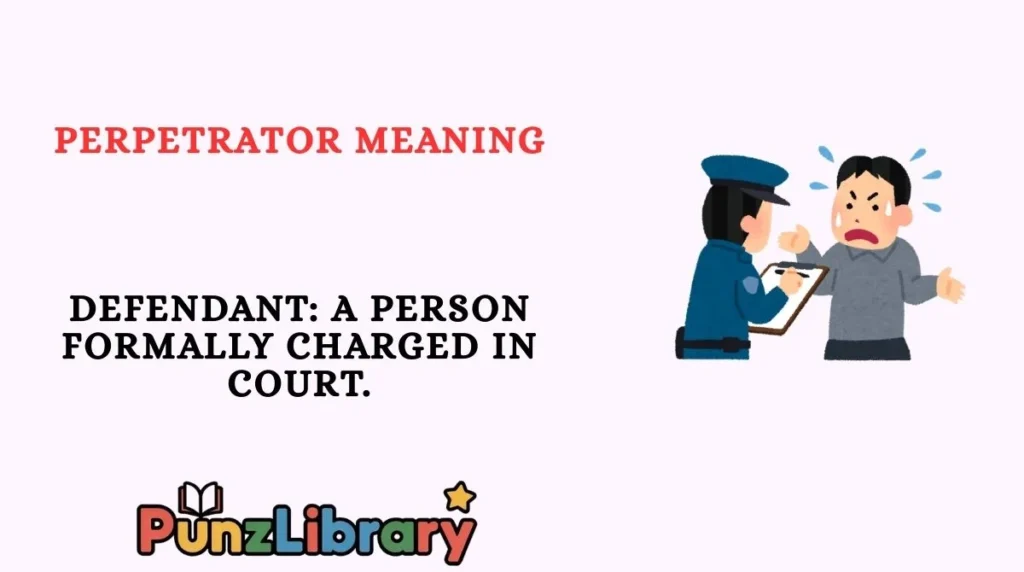
- Defendant: A person formally charged in court.
- Wrongdoer: General term for someone who has acted immorally or unethically.
Each word has subtle differences, so choosing the right term depends on context, formality, and certainty about the act.
Common Misunderstandings About Perpetrator
There are several misconceptions about the term perpetrator:
- “It means the person is always guilty.”
Not true—the term identifies someone who committed an act, but guilt is determined legally. - “It’s only for crimes.”
False—it can apply to harmful or unethical acts too, even outside formal law. - “It’s a judgment of character.”
No—it focuses on the action, not labeling someone’s entire personality. - “Only adults can be perpetrators.”
Wrong—minors can also commit acts that make them perpetrators in legal or social contexts. - “It’s interchangeable with ‘criminal.’”
Not exactly—criminal carries legal and moral weight, while perpetrator emphasizes responsibility for a specific act.
Being aware of these helps avoid misuse and promotes accurate communication.
Examples of Perpetrator in Sentences
Here are practical, everyday sentences using perpetrator:
- The police arrested the perpetrator of the robbery after reviewing CCTV footage.
- In online harassment cases, identifying the perpetrator quickly is crucial.
- She refused to forgive the perpetrator of the prank that embarrassed her at work.
- The counselor explained how a victim can report a perpetrator safely.
- News reports carefully referred to the perpetrator without assuming motives.
- Schools teach students how to handle situations when a perpetrator bullies others.
- Understanding the perpetrator’s actions helped the community prevent future incidents.
- Even when someone apologizes, the perpetrator must acknowledge responsibility.
Why Understanding Perpetrator Matters Today
In our fast-paced, information-heavy world, misunderstanding or mislabeling can have serious consequences. Recognizing who a perpetrator is—and what that entails—helps in:
- Promoting justice: Ensures accurate reporting and fair legal processes.
- Supporting victims: Gives clarity and validation to those affected.
- Preventing harm: Identifying responsibility allows interventions to stop repeated offenses.
- Improving communication: Using precise terms avoids misunderstandings and unnecessary stigma.
Simply put, knowing the perpetrator meaning helps us approach wrongdoing with clarity, fairness, and responsibility—qualities we need more than ever.
Frequently Asked Questions
What does perpetrator mean in simple words?
A perpetrator is someone who commits a harmful, illegal, or unethical act. It points to the action and responsibility, not character.
Is perpetrator positive or negative?
The term itself is neutral, but it usually refers to negative actions since it’s linked to wrongdoing or harm.
Where is perpetrator commonly used?
In legal reports, news media, educational programs, social discussions, and everyday conversations about accountability.
Is perpetrator formal or informal?
It is formal in tone, commonly used in law, journalism, and official reports, but can also appear in casual discussions to describe wrongdoing clearly.
Why do people search for perpetrator?
People search to understand its meaning, use it correctly in writing or speech, or clarify discussions about crime, accountability, or responsibility.
Conclusion
Understanding the perpetrator meaning is more than just a vocabulary lesson—it’s a tool for clarity, justice, and fair communication.
By knowing who commits an act and the implications of that responsibility, we can better navigate legal, social, and personal challenges.
Remember: acknowledging responsibility for actions, whether our own or others’, is the first step toward fairness and growth. Every act matters, and every step toward clarity strengthens our community and personal integrity.