Have you ever heard someone say, “Crossing the Rubicon” and wondered what it really means? Maybe it popped up in a movie, a book, or even in a motivational quote.
The term “Rubicon” carries a weight far beyond its literal sense—it’s about taking decisive action, embracing risks, and reaching a point of no return.
At its core, Rubicon means a critical boundary or threshold. Once crossed, there’s no turning back. Think about moments in life when you had to make a big decision—starting a new job, moving to a new city, or even confessing your feelings to someone. That feeling of “this changes everything” is what Rubicon captures so powerfully.
Understanding this term is more than just knowing a phrase—it helps us recognize decisive moments in our lives, in history, and in everyday conversations. By exploring its origin, practical uses, and emotional significance, you’ll see why the Rubicon still matters today.
What Does Rubicon Mean?
In simple, everyday words, Rubicon refers to a point of no return. It’s that moment when a choice is made, action is taken, or a line is crossed, after which things cannot go back to the way they were.
Here are a few examples:
- Career Change: Deciding to quit a stable job to start your own business can feel like crossing the Rubicon. Once you take that leap, there’s no going back to your old routine.
- Relationships: Confessing love to someone can be a Rubicon moment—you’ve put your feelings on the line, and the relationship may never be the same again.
- Travel & Adventure: Leaving your hometown to live abroad permanently is a personal Rubicon. You’re stepping into an unknown world, fully aware there’s no easy return.
In all these cases, the Rubicon symbolizes boldness, courage, and the acceptance of consequences.
Origin and Background of the Term
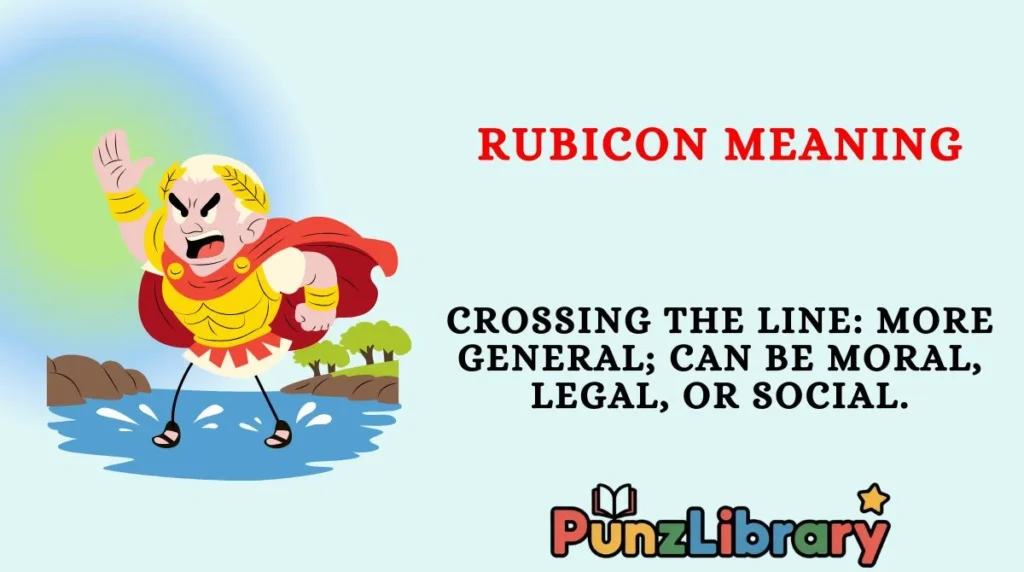
The story of Rubicon is steeped in history and drama. The Rubicon is actually a small river in northern Italy. In 49 BC, Julius Caesar crossed this river with his army, an act that defied the Roman Senate and marked the start of a civil war.
Why was this significant? At the time, Roman law forbade generals from bringing armies into Italy proper. Crossing the Rubicon wasn’t just a physical act—it was a declaration of defiance, a bold move that changed the course of history. Caesar reportedly said, “Alea iacta est” or “The die is cast”, emphasizing that once the decision was made, there was no turning back.
This historical moment transformed “Rubicon” into a metaphor for any decision or action that is irreversible and transformative. It’s fascinating how a small river became a symbol of courage, risk, and commitment that still resonates today.
How Rubicon Is Used in Daily Life
While the term has ancient roots, we use it in modern life all the time—sometimes without realizing it. Here are practical examples:
- Starting a New Venture: Entrepreneurs often describe launching a business as crossing the Rubicon because it involves commitment and risk.
- Major Purchases: Buying a house or car after months of saving can feel like a Rubicon moment. Once you sign, the decision is final.
- Health Choices: Deciding to undergo surgery or commit to a rigorous fitness journey can be a Rubicon in personal health.
- Education: Accepting admission to a college far from home is another personal Rubicon—your life trajectory changes.
- Social Commitments: Making a public stand for a cause or joining a movement can feel irreversible, much like crossing a Rubicon.
The beauty of the term is that it’s universally relatable. Everyone faces a Rubicon moment in their own way, whether big or small.
Emotional or Practical Meaning of Rubicon
Beyond history, Rubicon has emotional and cultural significance. Psychologically, it represents courage and commitment. Crossing a Rubicon is often scary—it’s stepping out of comfort zones and embracing uncertainty.
In modern culture, we see it in movies, books, and motivational speeches. It’s a metaphor for personal growth, transformation, and risk-taking. For instance, athletes, leaders, and artists often face Rubicon moments where their decisions define their future.
The emotional impact of recognizing a Rubicon moment is powerful. It teaches us responsibility, resilience, and self-awareness, reminding us that decisions carry weight—and sometimes, that weight is liberating.
Similar or Related Terms
Here are a few terms related to Rubicon, along with how they differ:
- Point of no return: Almost identical; emphasizes irreversible action.
- Crossing the line: More general; can be moral, legal, or social.
- Leap of faith: Highlights trust and courage, less about irreversibility.
- Turning point: Broader; may not always be irreversible.
- Moment of decision: Neutral; describes choice without emotional weight.
Understanding these distinctions helps you use Rubicon accurately in conversation or writing.
Common Misunderstandings About Rubicon
- It’s just a river: While literally true, the figurative meaning is far more important.
- Only historical context matters: No—Rubicon is widely used in modern life.
- It’s always dramatic: Not necessarily; small decisions can also be personal Rubicons.
- Positive or negative only: Rubicon is neutral—it depends on the consequences.
- Everyone understands it: Many people hear it in passing without grasping the depth of its meaning.
- It’s formal language: It can be used in casual conversations if explained well.
Examples of Rubicon in Sentences
- She knew quitting her job was a Rubicon she couldn’t uncross.
- Moving abroad for studies was his personal Rubicon moment.
- Deciding to adopt a child felt like crossing the Rubicon of responsibility.
- The company’s investment in AI marked a Rubicon in its growth strategy.
- Signing the contract was the Rubicon she had been preparing for.
- His apology crossed a Rubicon in mending the broken friendship.
- Starting her YouTube channel was a small but meaningful Rubicon.
- When he proposed, it felt like a Rubicon of emotional commitment.
Why Understanding Rubicon Matters Today
In a fast-paced world, recognizing your Rubicon moments can be life-changing. It teaches you to evaluate choices carefully, embrace risks, and understand that some decisions cannot be undone.
From personal growth to professional decisions, Rubicon moments shape our identity and trajectory. They remind us that bold action often leads to progress, and hesitation can sometimes hold us back.
By understanding this term, you gain not only linguistic knowledge but also practical wisdom for life. Knowing when you’re at a Rubicon helps you act with confidence and clarity.
Frequently Asked Questions
What does Rubicon mean in simple words?
Rubicon means a point of no return, a decision or action after which things cannot go back to the way they were.
Is Rubicon positive or negative?
It’s neutral. The consequences can be positive, negative, or mixed—it depends on the situation.
Where is Rubicon commonly used?
In history, literature, business, self-help, and everyday life when describing irreversible actions.
Is Rubicon formal or informal?
It can be both. Suitable for academic, professional, or casual use, depending on context.
Why do people search for Rubicon?
People want to understand decisive moments, metaphorical language, and historical references that enrich communication and writing.
Conclusion
The Rubicon isn’t just a river—it’s a symbol of courage, choice, and change. From Caesar’s daring act to everyday life decisions, it reminds us that some moments define our path forever.
Next time you face a major choice, remember: crossing your Rubicon can be scary, but it’s also where growth begins.
Embrace the moment, own your decisions, and step forward with confidence. Life’s most meaningful changes often start at your personal Rubicon.