Have you ever paused before making a risky decision and felt that instinct deep inside telling you to step back? That gut reaction is what we often call self-preservation.
In simple terms, self-preservation meaning refers to the natural instinct to protect yourself from danger, harm, or emotional stress. It’s a basic part of being human—and yet, it’s so much more than just avoiding physical threats.
Understanding self-preservation helps us navigate life wisely. It explains why we avoid toxic people, why we leave unsafe situations, or even why we sometimes put our needs before others.
By recognizing this instinct, you can make better decisions, balance your emotions, and live a safer, healthier life. In this article, we’ll explore what self-preservation really means, its history, practical examples, and why it’s so relevant in today’s fast-paced world.
What Does Self Preservation Mean?
At its core, self-preservation is all about protecting yourself—physically, emotionally, or mentally. It’s an instinct we share with every living creature, from the tiniest insect to humans. But in humans, it’s not just about survival—it’s also about maintaining well-being, avoiding harm, and ensuring safety.
Real-Life Examples:
- Physical safety: Stepping away from a dangerous road when a car is speeding towards you.
- Emotional safety: Ending a friendship that consistently brings stress or sadness.
- Financial safety: Saving money instead of spending recklessly to ensure long-term security.
In every example, self-preservation is the inner voice nudging you to make choices that protect your life, health, or peace of mind.
Origin and Background of the Term
The concept of self-preservation dates back thousands of years. Philosophers and scientists alike have studied it as one of the most basic instincts of living beings. Charles Darwin, in his work on natural selection, described survival instincts as essential for species to thrive. In human history, self-preservation was crucial—whether avoiding predators, natural disasters, or conflicts.
Even in language, the term self-preservation became popular in English during the 17th century, emphasizing not just survival, but the active effort to protect oneself. Over time, it evolved from being purely physical to including emotional, mental, and social aspects. Today, it’s a holistic concept that applies to all areas of life.
How Self Preservation Is Used in Daily Life
Self-preservation isn’t just a philosophical idea—it’s part of everyday choices. Here are some practical ways it shows up:
- Walking away from conflict: Instead of arguing endlessly, you leave a tense situation to protect your mental health.
- Listening to your gut: Avoiding strangers or situations that feel unsafe.
- Setting boundaries: Saying no when someone is overstepping or draining your energy.
- Healthy habits: Eating well, exercising, and sleeping enough to protect your body.
- Financial planning: Avoiding risky investments that could jeopardize your security.
- Social awareness: Choosing supportive friends over those who are toxic or manipulative.
In all these cases, self-preservation is the quiet, guiding force that helps you survive and thrive.
Emotional or Practical Meaning of Self Preservation
Self-preservation isn’t just about surviving—it’s about valuing your well-being. Emotionally, it’s about protecting your mental space and avoiding unnecessary stress. Practically, it’s about making choices that keep you safe and secure.
Culturally, self-preservation is often praised but sometimes misunderstood. For example, some might see it as selfishness, but in reality, it’s about self-respect and self-care. In today’s world, where stress and risks are everywhere—from online threats to personal burnout—understanding this instinct helps you live consciously, not reactively.
Similar or Related Terms
- Self-care: Activities you do to maintain your health and happiness.
- Self-defense: Physical techniques or strategies to protect yourself from harm.
- Self-preservation instinct: The innate drive to survive, often subconscious.
- Risk management: Evaluating choices to avoid danger or loss.
- Boundaries: Limits you set to protect your mental and emotional well-being.
While each term overlaps with self-preservation, the key difference is that self-preservation is broader and instinct-driven, covering physical, emotional, and social aspects.
Common Misunderstandings About Self Preservation
- It’s selfish: Protecting yourself doesn’t mean ignoring others—it’s about balance.
- It’s only physical: Emotional and mental safety are equally part of self-preservation.
- It’s weakness: Choosing to step back often requires strength and wisdom.
- It’s overthinking: Gut instincts are real, and caution can save lives.
- It’s a modern concept: Humans have practiced self-preservation since ancient times.
- It’s negative: Self-preservation actually enhances long-term happiness and safety.
By clearing up these myths, you can embrace self-preservation without guilt or fear.
Examples of Self Preservation in Sentences
- She practiced self-preservation by leaving the stressful job before it harmed her health.
- His instinct for self-preservation told him to avoid walking alone at night.
- Saving a portion of her salary every month was a form of financial self-preservation.
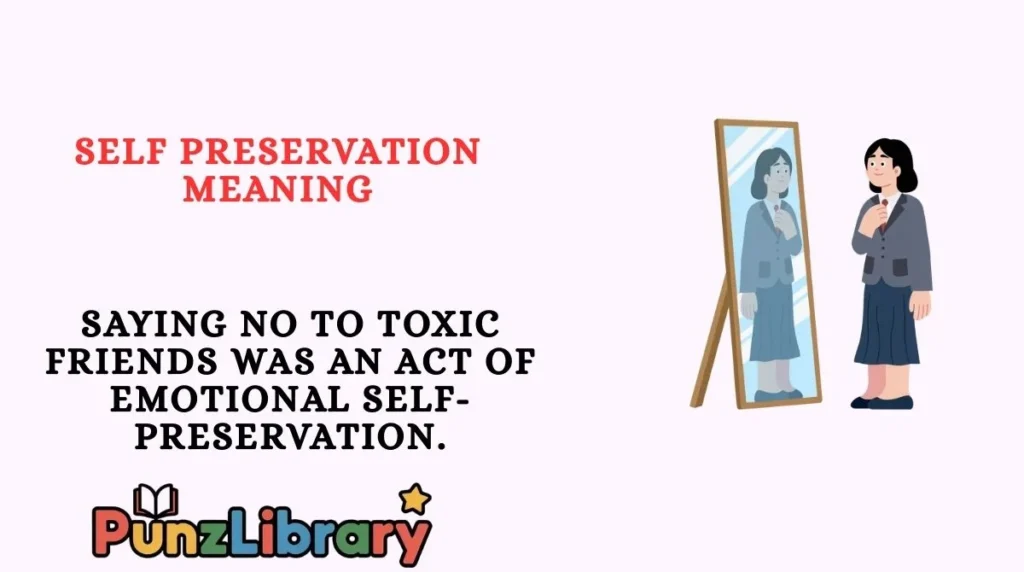
- Saying no to toxic friends was an act of emotional self-preservation.
- Wearing a helmet while cycling is simple but important self-preservation.
- He avoided online scams as a matter of personal self-preservation.
- Listening to your intuition is sometimes the most critical act of self-preservation.
- Self-preservation motivated her to speak up before the situation got worse.
Why Understanding Self Preservation Matters Today
In a fast-paced, unpredictable world, understanding self-preservation is more important than ever. From mental health to online security, from relationships to finances, this instinct guides smart decisions. People who recognize their self-preservation instincts are often more resilient, confident, and aware of their limits.
It’s not about fear—it’s about empowerment. By honoring this instinct, you protect yourself while still growing, connecting, and thriving. It’s a balance between caution and courage, instinct and reflection.
Frequently Asked Questions
What does self preservation mean in simple words?
It means taking actions to protect yourself—physically, emotionally, or mentally—from harm or danger.
Is self preservation positive or negative?
Self-preservation is positive. It helps you survive, stay safe, and maintain well-being.
Where is self preservation commonly used?
It’s used in daily life, psychology, philosophy, personal safety, and even financial planning.
Is self preservation formal or informal?
The term is neutral. It can be used in casual conversation or academic writing.
Why do people search for self preservation meaning?
People want to understand their instincts, make better choices, and protect themselves in life.
Conclusion
Self-preservation is a natural, powerful instinct that keeps us safe, strong, and resilient. It’s not selfish or weak—it’s a sign of self-respect and wisdom.
By understanding it, you can navigate life’s challenges with confidence, set healthy boundaries, and make decisions that truly protect your well-being.
Remember, listening to your inner voice isn’t just smart—it’s essential. Protect yourself, grow with courage, and embrace the journey of life fully.