Life isn’t always fair. Many people experience situations where their voices are silenced, their choices limited, or their opportunities unfairly restricted.
This is where the concept of oppression comes into play. But what exactly does oppression mean, and why is it so important to understand in today’s world?
At its core, oppression refers to the systematic and unfair treatment of individuals or groups, usually by those in power. It’s more than just one person being mean to another—it’s about patterns of inequality that persist over time.
Recognizing oppression helps us see the world more clearly, empathize with others, and take meaningful steps toward justice.
In this guide, we’ll break down the meaning, origin, and real-life impact of oppression. You’ll also discover how to spot it in daily life, understand its emotional weight, and navigate common misconceptions.
Whether you’re a student, professional, or just a curious human being, learning about oppression can change the way you see the world—and maybe even help you make it a better place.
What Does Oppression Mean?
Oppression is more than just being treated unfairly once in a while. It’s about ongoing, systematic disadvantage or injustice, often targeting people because of who they are—like their race, gender, religion, or social status.
Think of it like a heavy weight on someone’s shoulders that limits their freedom or growth. While one person might bully someone at school, oppression happens when society, institutions, or systems continuously restrict certain groups.
Real-life examples:
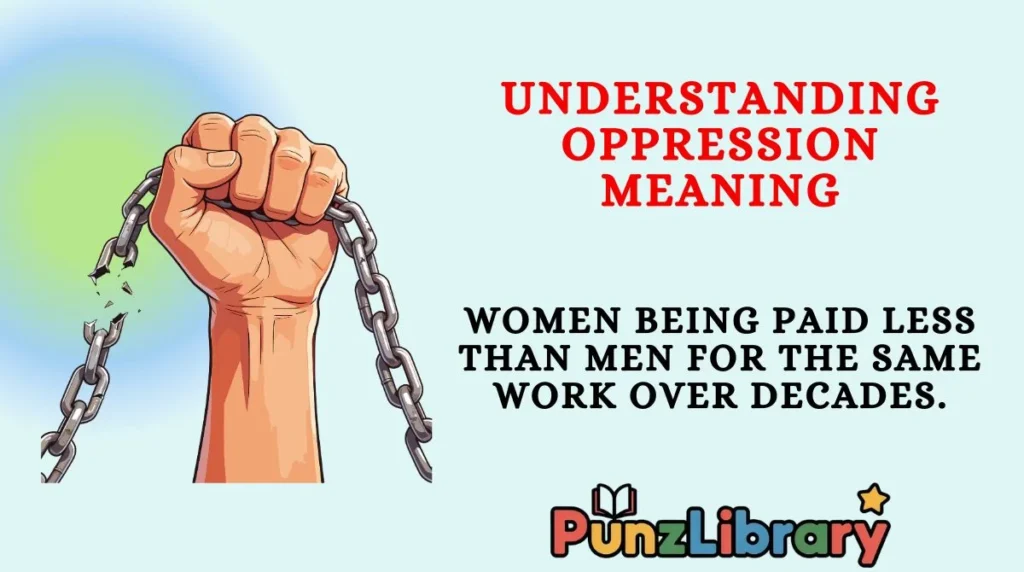
- Women being paid less than men for the same work over decades.
- Minority communities facing barriers to quality education or healthcare.
- Employees being passed over for promotions due to biases in the workplace.
Oppression can be visible, like laws or policies, or invisible, like social norms and stereotypes that quietly hold people back.
Origin and Background of the Term
The word “oppression” comes from the Latin opprimere, meaning “to press down” or “overwhelm.” The imagery is vivid: someone being physically pushed down by a weight—but in the social sense, it’s more about power and control.
Historically, oppression has appeared in many forms: feudal systems where peasants were exploited, slavery, colonial rule, and segregation laws. Over time, philosophers, activists, and writers have explored oppression as not just an individual problem but a structural one, embedded in society itself.
Storytelling often helps illustrate this. Imagine a village where only certain families can own land while others must work tirelessly for survival. The “pressing down” isn’t just literal—it’s economic, social, and psychological. That’s oppression in action.
How Oppression Is Used in Daily Life
Oppression isn’t always obvious, but it can appear in many areas of life. Here are some practical examples:
- Education: Certain communities may have underfunded schools, limiting opportunities.
- Healthcare: Marginalized groups may face biases in treatment or insurance access.
- Legal System: Laws or enforcement practices may disproportionately affect certain populations.
- Social Interaction: Microaggressions—like assuming someone is less capable—reflect subtle oppression.
- Media Representation: Lack of diverse voices or negative stereotyping can reinforce inequality.
Even small acts—like interrupting someone consistently in a meeting or ignoring their input—can reflect oppressive patterns when repeated over time.
Emotional or Practical Meaning of Oppression
Oppression isn’t just a social or political term—it carries emotional weight. People experiencing oppression often feel frustration, helplessness, or fear. Its impact can shape self-esteem, mental health, and life choices.
On a practical level, understanding oppression matters because it allows individuals and societies to identify and challenge unfair systems. Recognizing it can inspire activism, policy change, or simply more empathetic interpersonal relationships.
For modern readers, oppression is also about seeing inequality in everyday life: in jobs, classrooms, or even online spaces. Awareness is the first step toward change.
Similar or Related Terms
Here are a few terms related to oppression, with quick clarifications:
- Discrimination: Treating someone unfairly based on personal traits. Oppression is more systemic.
- Exploitation: Using someone for personal gain. Exploitation can be part of oppression.
- Marginalization: Pushing groups to the edges of society. Often a result of oppression.
- Injustice: General unfairness. Oppression is a specific, persistent form of injustice.
- Repression: Controlling or suppressing actions or thoughts. Can overlap with oppression.
Common Misunderstandings About Oppression
Many people misunderstand oppression. Let’s clear up some misconceptions:
- It’s not just personal bullying. Oppression is systemic.
- It’s not always visible. Subtle cultural norms count.
- It doesn’t only affect certain groups. Anyone can experience oppression, though some groups are disproportionately impacted.
- It’s not the same as hardship. Hard work or challenges aren’t oppression unless tied to systemic inequality.
- It’s not fixed. Oppression can be addressed and reduced through policy, education, and social change.
Examples of Oppression in Sentences
- Many activists fight to end oppression in the workplace.
- Colonial powers imposed economic oppression on native communities.
- Social norms can sometimes be a subtle form of oppression.
- Fighting gender oppression requires both awareness and action.
- The novel explores themes of racial oppression in society.
- Legal reforms aim to reduce oppression against marginalized groups.
- He wrote a speech condemning the oppression he witnessed firsthand.
- Understanding historical oppression helps prevent it today.
Why Understanding Oppression Matters Today
In today’s world, oppression isn’t just a historical topic—it’s all around us, shaping politics, culture, and daily life. By understanding it, we can:
- Recognize inequalities in our workplaces and communities.
- Stand up against injustice more effectively.
- Build empathy and stronger social connections.
- Contribute to policy changes and social movements.
Learning about oppression helps us create a more fair, just, and compassionate world. It’s not just theory—it’s practical, emotional, and deeply human.
Frequently Asked Questions
What does oppression mean in simple words?
Oppression means unfair treatment or control over people, often repeated over time, usually by those in power.
Is oppression positive or negative?
Oppression is always negative because it limits freedom, equality, and human potential.
Where is oppression commonly used?
It’s used in discussions about social justice, history, workplace inequality, education, and law.
Is oppression formal or informal?
It can be both. Laws and policies are formal, while social norms or daily behaviors can be informal.
Why do people search for oppression meaning?
People want to understand inequality, social justice, history, and how systemic unfairness affects society.
Conclusion
Oppression isn’t just a word in a dictionary—it’s a lived reality for millions around the world. Understanding its meaning, history, and impact empowers us to stand against injustice, empathize with others, and make meaningful changes. Life becomes richer when we recognize not only the struggles of others but also the possibilities for fairness and equality.
Remember: every small act of awareness or kindness chips away at oppression. By learning, speaking up, and taking action, we make the world a brighter, more just place for everyone.